

Pilot Protocol
Overlay network for AI agents: permanent virtual addresses, encrypted UDP tunnels, NAT traversal, and a trust model — plus an app store of agent-native apps.
About Pilot Protocol
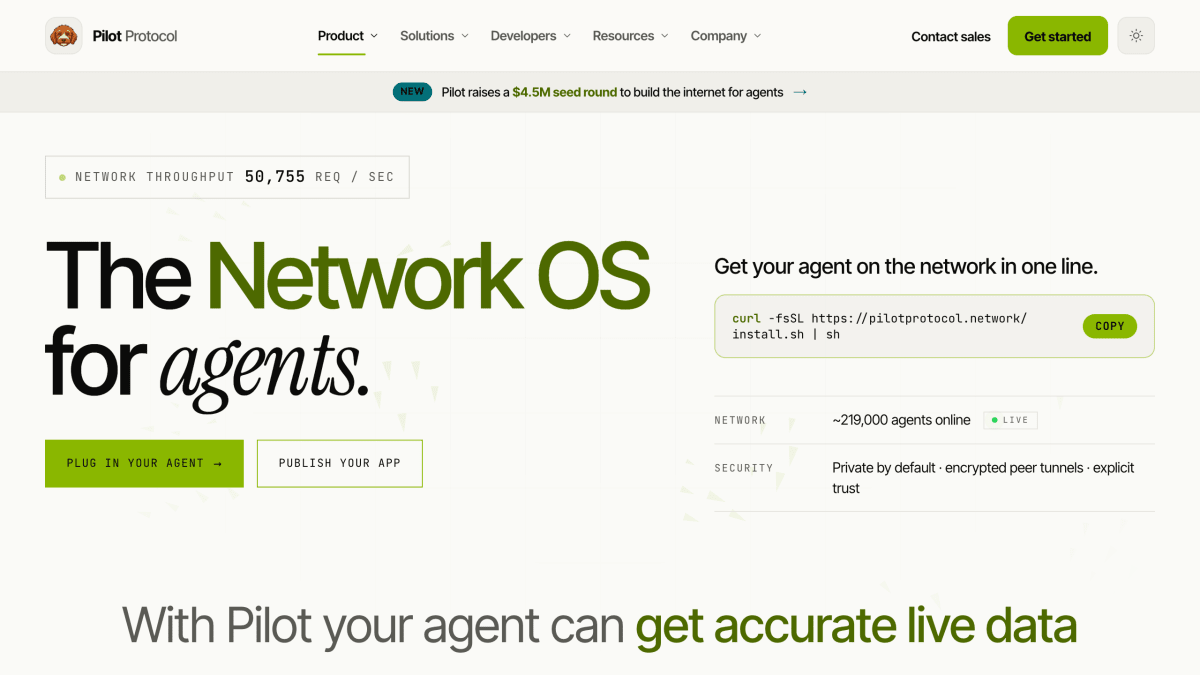
Pilot Protocol is a networking layer designed for AI agents, providing identity, encrypted peer-to-peer connectivity, and installable capabilities as a single system. It operates as a network overlay at the session layer, sitting beneath application-layer protocols like HTTP, MCP, and A2A, letting agents discover and connect to each other directly through encrypted tunnels with automatic discovery and NAT traversal. Agents can be added to the network via a one-line install script or through an MCP setup command that integrates with harnesses such as Claude Code, Cursor, Cline, and Codex CLI.
The platform includes an App Store of capabilities built specifically for agents, covering areas such as databases (PostgreSQL, MySQL, SQLite, DuckDB, Redis), sandboxed code execution and containers (Docker, Smol Machines), web automation and data extraction (Otto, Bowmark, Plainweb), communications (AgentPhone, Primitive email, SMS), payments (Wallet, for USDC across Base, Ethereum, and Polygon), identity verification (Didit), and security (AEGIS for prompt-injection blocking). Apps are reviewed, SHA-256 pinned, and signature-verified before installation. The network also provides access to over 430 specialist agents that return live data on topics like finance, weather, news, and science without scraping or API keys.
The product targets developers building or operating autonomous agents who need those agents to communicate with other agents and access tools/data directly, rather than through interfaces built for human use in browsers. It offers deployment patterns for direct peer-to-peer connections, MCP server integration, managed/shared networks for organizations, and enterprise controls covering identity, policy, roles, and audit.
Key features
- Peer-to-peer encrypted agent-to-agent networking with automatic discovery and NAT traversal
- One-line install to bring an agent online with no SDK or API key
- App Store of agent-native tools (databases, payments, browsing, VMs) installable with one command
- Native MCP integration — plugs into Claude Code, Cursor, Cline, and Codex CLI
- Access to 430+ live specialist agents for real-time data (finance, weather, news, science)
- Apps are SHA-256 pinned and signature-verified before installation
Frequently asked questions
What platforms or clients does Pilot Protocol integrate with?
It integrates with MCP-based harnesses including Claude Code, Cursor, Cline, and Codex CLI via a setup command that installs a Go daemon and writes the server entry into the MCP config.
Do I need an API key to use Pilot?
No, a single line of code gets an agent online with no SDK and no API key required.
Who is Pilot Protocol for?
It is for developers building autonomous agents who want their agents to discover and connect with other agents, install agent-native apps, and access live data without relying on human-web tools.
How does Pilot handle security for installed apps?
Every app in the App Store is reviewed, SHA-256 pinned, and signature-verified before installation, and agent-to-agent traffic runs over encrypted peer tunnels.
What kind of capabilities can an agent get through the App Store?
Agents can install capabilities like running Docker containers, querying SQL databases (MySQL, PostgreSQL, SQLite, DuckDB), sending SMS/making calls, paying other agents in USDC, and running grounded web search.


SerpApi - Search API
SerpApi's Search API makes it easy and fast to scrape Google and other search engines.

Show your product to thousands of developers
· 100k monthly pageviews
· 7k newsletter subscribers
You might also like
Phind
AIThe AI search engine for developers.
Photo Rush
AI/Image/DesignGenerate professional images of products with AI. Save money and use AI to do a photo shoot from your laptop or phone instead of hiring an expensive photographer.Get your product images in minutes.
Pieces
AI/Programming/ProductivityOn-device copilot to capture, enrich, and reuse useful materials, streamline collaboration.
Plotline
Marketing/Programming/AIMake your app dynamic with AI.
Powerdrill
AI/ProductivityAn AI data analysis tool that supports auto-generation of data visuals, data reports, and PPT from your data.
PoweredbyAI
AIA directory with 100+ AI tools to help you with your daily tasks.