

KitOps
Simple, secure, and reproducible packaging for AI/ML projects.
About KitOps
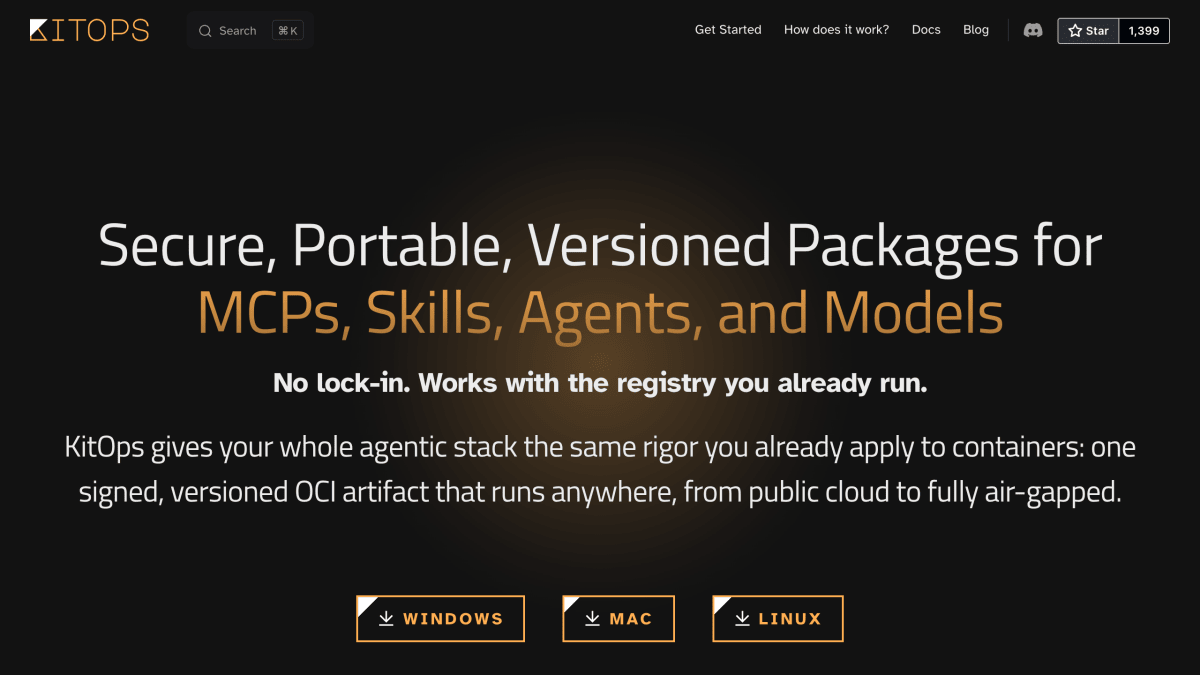
KitOps is a packaging and versioning tool for AI projects, distributed as a CLI (Kit) and a Python SDK (PyKitOps). It bundles models, datasets, code, agent skills, MCP servers, guardrail configs, and policies into a single versioned, immutable OCI artifact called a ModelKit, which can be stored in any OCI-compliant registry such as Docker Hub, ECR, GCR, Harbor, Artifactory, or Jozu Hub. Individual components within a ModelKit can be pulled separately rather than requiring the whole package.
The tool supports signing and verification with Cosign, SHA-256 hashing of every component for tamper detection, and generation of AI Bills of Materials mapped to EU AI Act and NIST AI RMF requirements. It integrates with CI/CD through a GitHub Action or other major CI/CD tools, and can automatically generate a container from a ModelKit. It is open source under the Apache 2.0 license.
KitOps is aimed at organizations running AI projects across data science, application development, and deployment teams, where models, datasets, and configurations need to be handed off between teams with version tracking and integrity verification. It positions itself as an alternative to using Git (which handles large model/dataset files inefficiently via LFS) or ad-hoc combinations of zip files and git submodules for coordinating AI project artifacts.
Key features
- Packages models, datasets, agent skills, MCP servers, and configs into a single versioned OCI artifact
- Signs and verifies artifacts with Cosign and generates SBOM-ready evidence with SHA-256 hashing
- Works with existing OCI-compliant registries like Docker Hub, ECR, GCR, Harbor, and Artifactory
- Docker-like CLI (kit pack, push, pull, tag) with a Python SDK (PyKitOps) for MLflow and other pipelines
- CI/CD integration via a GitHub Action or other major CI/CD tools
- Generates AI Bills of Materials mapped to EU AI Act and NIST AI RMF requirements
Frequently asked questions
Is KitOps free to use?
Yes, KitOps is open source under the Apache 2.0 license and welcomes all users and contributors.
What registries can I use to store ModelKits?
ModelKits can be stored in any OCI-compliant registry, such as Docker Hub, ECR, GCR, Harbor, Artifactory, or Jozu Hub.
Does KitOps replace Docker containers?
No, ModelKits complement containers, and KitOps can even generate a container for a model automatically from a ModelKit.
Why use KitOps instead of Git for versioning models and datasets?
Git and Git LFS treat large models and datasets as atomic blobs, making it inefficient and hard to detect tampering, whereas ModelKits track SHA digests for the kit and every artifact it holds.
What languages or tools integrate with KitOps?
KitOps offers a Docker-like CLI and a Python SDK (PyKitOps), and it integrates with CI/CD tools via a GitHub Action, plus works with tools like MLflow since ModelKits are OCI-compatible artifacts.


SerpApi - Search API
SerpApi's Search API makes it easy and fast to scrape Google and other search engines.

Show your product to thousands of developers
· 100k monthly pageviews
· 7k newsletter subscribers
You might also like
Interview Solver
Interview/AIAce your live coding interviews with our AI Copilot.
InterviewPal
AI/Job/ResumeInterviewPal is an AI-powered platform that helps developers and career changers prepare for interviews with personalized simulations and feedback.
Jsonify
AI/Programming/Code SnippetJsonify is an AI "data intern" in the cloud -- an intelligent AI agent that can automate data collection and maintenance tasks involving the web and documents. Never update a spreadsheet yourself again!
Kraftful
Productivity/Analytics/AICopilot for product teams.
Labrynth AI
AIAI regulatory intelligence platform that turns complex requirements into cited, audit-ready outputs.
Landing AI
AI/Website BuilderMake a stunning landing page with AI in seconds. Get your perfect copywriting, color board, logo and illustrations thanks to generative Artificial Intelligence.