


Heroku
Heroku is a platform as a service (PaaS) that enables developers to build, run, and operate applications entirely in the cloud.
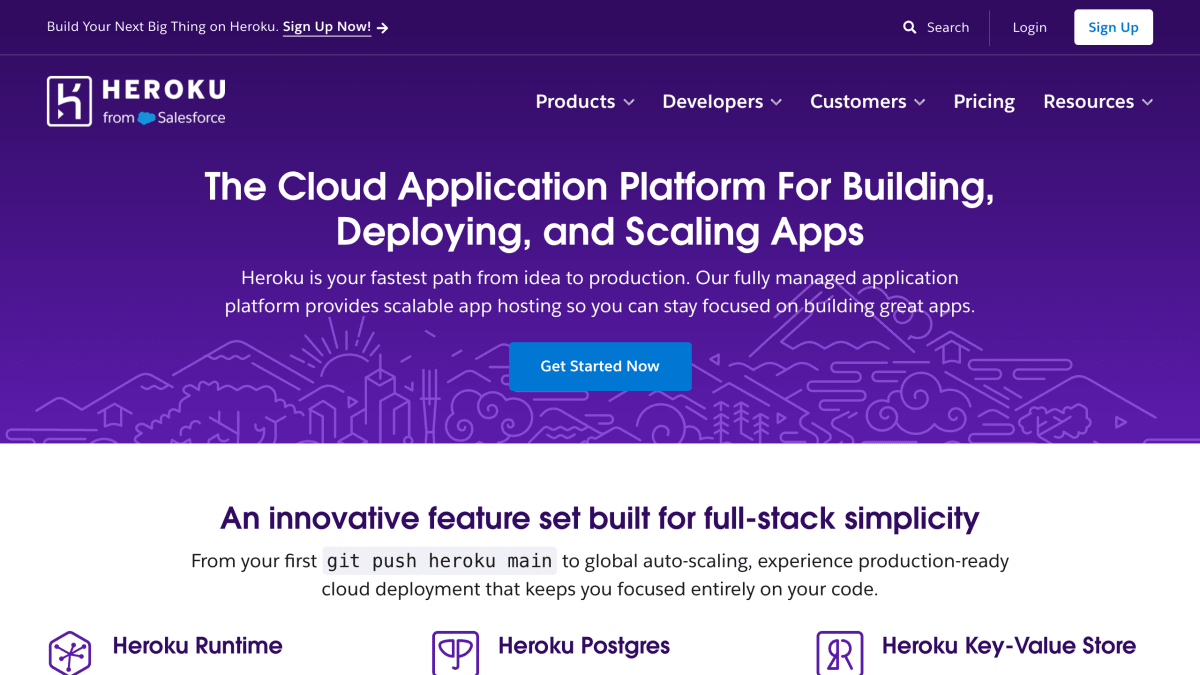
About Heroku
Heroku is a cloud platform-as-a-service for building, deploying, and scaling web applications. Apps run inside managed containers called dynos, and the platform includes managed data services such as Heroku Postgres and a Redis-compatible key-value store. Deployment is git-based (e.g., "git push heroku main"), with features including GitHub integration for review apps and branch deploys, Heroku Flow for continuous delivery, fast rollback for code and Postgres data, and app metrics for monitoring runtime performance.
The platform officially supports Node.js, Ruby, Java, PHP, Python, Go, Scala, Clojure, and .NET, with additional language support available through third-party buildpacks. It is extensible through Heroku Elements, which includes over 150 third-party add-ons and 380+ open source buildpacks. Heroku Teams provides tools for managing people, app-level permissions, and billing for collaborative software delivery.
Heroku also offers Heroku AI, which provides managed inference and agents accessible via commands like "heroku ai:models:create", along with support for Model Context Protocol (MCP). The platform maintains PCI, HIPAA, ISO, and SOC compliance certifications and offers an Enterprise tier for larger organizations, along with tiered support options ranging from Standard to Signature.
Key features
- Deploys apps via git push into managed containers called dynos
- Fully managed PostgreSQL database service (Heroku Postgres)
- Managed Redis key-value store service
- Instant rollback of code or Postgres data to an earlier state
- GitHub integration with disposable Review Apps per pull request
- Managed AI model inference and agents with MCP support
Frequently asked questions
What languages does Heroku support?
Heroku officially supports Node.js, Ruby, Java, PHP, Python, Go, Scala, Clojure, and .NET, and any other language that runs on Linux via a third-party buildpack.
How do I deploy an app to Heroku?
You deploy using a git push, and Heroku runs your app inside managed containers called dynos.
Does Heroku offer compliance certifications?
Yes, Heroku maintains PCI, HIPAA, ISO, and SOC compliance and regularly performs audits.
Can I extend Heroku with add-ons?
Yes, Heroku offers an ecosystem of 150+ third-party add-ons and 380+ open source buildpacks.
Does Heroku support team collaboration?
Yes, Heroku Teams lets you manage people, app-level permissions, software delivery, and billing.


SerpApi - Search API
SerpApi's Search API makes it easy and fast to scrape Google and other search engines.

Show your product to thousands of developers
· 100k monthly pageviews
· 7k newsletter subscribers
You might also like
Gcore Basic
HostingVirtual machines for various tasks: from hosting a cooking blog to making a backup server.
GitHub Pages
HostingWebsites for you and your projects, hosted directly from your GitHub repository. Just edit, push, and your changes are live.
GoDaddy
Domain/Hosting/Website BuilderYour all in one solution to grow online. Start a free trial to create a beautiful website, get a domain name, fast hosting, online marketing and award-winning 24/7 support.
Hostman
HostingCloud hosting for startups and developers.
Kinsta
Hosting/Cloud Computing/DatabaseKinsta is a Cloud Platform designed to help your company and dev teams ship web projects faster and more efficiently. You can host your apps, databases, and sites all in one place. Easily connect with GitHub and automate deployments and get 24/7 support for all your favorite languages and frameworks.
Kube-DC Cloud
Hosting/Cloud ComputingA Kubernetes-native cloud platform to manage VMs, Kubernetes clusters, databases, and networks via manifests, AI assistants, or a real-time web console — all running in a fixed-price resource pool starting at €19/mo, hosted in Amsterdam.