


gitty
Git workflow CLI tool. Stage, commit, and push in one command, with selective line commits, interactive conflict resolution, and history rewriting.
About gitty
gitty is a single-binary command-line tool that wraps Git and the GitHub CLI (gh) into shorter, semantic commands. It combines common multi-step sequences, such as staging, committing, and pushing, into single commands like gitty up, and supports symbolic shortcuts (=, ~, *) to indicate destination, source, and branch context in commands such as gitty push=main and gitty pull~main. It has no runtime dependencies (no Node or Python required) and no configuration files.
The tool covers repository and branch operations (init, clone, create/rename repos and branches), daily workflow commands (add, commit, push, pull with safe and hard modes), and history/conflict tools (log with time-range filters, tagged checkpoints, restoring to a tag, and interactive merge-conflict resolution via gitty fix). It integrates with GitHub through gh for actions like creating repositories and generating shareable push links.
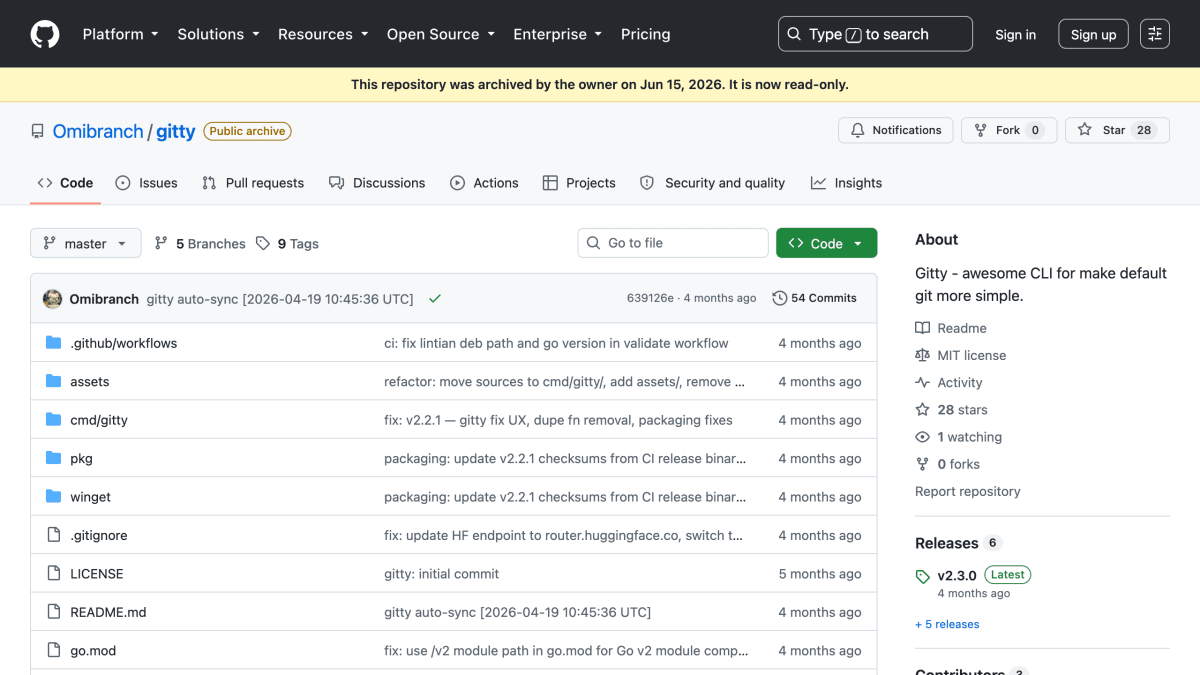
It is installable via winget on Windows, via the AUR (package name gitty-cli) on Arch Linux, via Homebrew on macOS/Linux, via an install script, or by downloading the binary manually from Releases. The repository is a public archive on GitHub and was archived by its owner on June 15, 2026; it is now read-only. Documentation is available in English and Russian.
Key features
- Single-binary CLI wrapping Git and GitHub commands with no runtime dependencies
- Combines stage, commit, and push into one command (gitty up)
- Semantic shortcut syntax using =, ~, * symbols for destination, source, and branch context
- Interactive merge conflict resolution via gitty fix
- Safe-by-default pull that only adds missing files, with explicit flags for destructive operations
- GitHub-native repo and branch management through gh integration
Frequently asked questions
What platforms does gitty support?
gitty installs on Windows via winget, macOS/Linux via Homebrew or an install script, and Arch Linux via the AUR package gitty-cli.
Does gitty require any dependencies?
No, gitty is a single binary with no runtime dependencies, no Node or Python, and no config files.
Is gitty still maintained?
No, the repository was archived by the owner on Jun 15, 2026 and is now read-only.
How does gitty integrate with GitHub?
It uses the gh CLI to create repos, push with sharing links, and manage branches directly.
Is gitty free to use?
The page does not mention any pricing, so gitty's cost is not specified in the content provided.


SerpApi - Search API
SerpApi's Search API makes it easy and fast to scrape Google and other search engines.

Show your product to thousands of developers
· 100k monthly pageviews
· 7k newsletter subscribers
You might also like
BragDoc
Productivity/Terminal/ToolingCLI tool that extracts achievements from git commits for performance reviews.
cmd challenge
TerminalLearn the command line.
Dracula theme
Editor/Extension/TerminalDracula is a color scheme for code editors and terminal emulators such as Vim, Notepad++, iTerm, VSCode, Terminal.app, ZSH, and much more.
Emacs
Editor/TerminalEmacs or EMACS is a family of text editors that are characterized by their extensibility. The manual for the most widely used variant, GNU Emacs, describes it as "the extensible, customizable, self-documenting, real-time display editor".
explainshell
TerminalMatch command-line arguments to their help text.
Tura
AI/Programming/TerminalTura is a local, open-source coding agent for developers tired of vague claims, evidence-free token-saving tools, and agents that edit before understanding.