

HarperDB
HarperDB is a database and application development platform that is focused on performance and ease of use.
About HarperDB
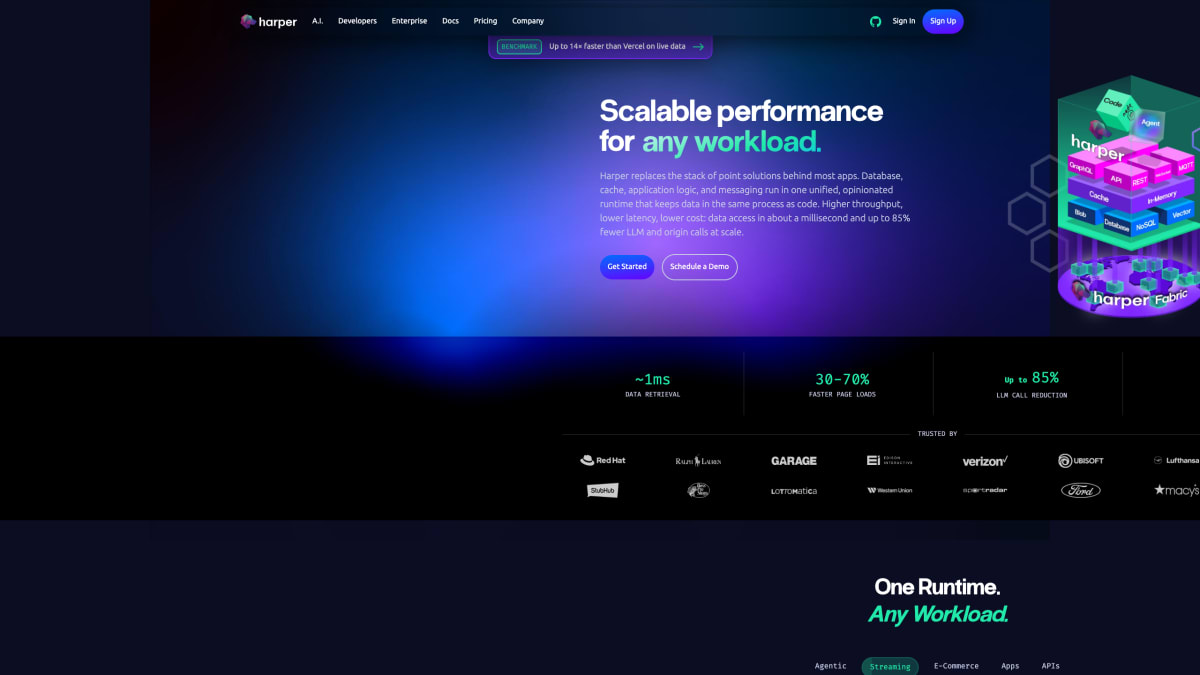
HarperDB (Harper) is a unified runtime that combines a database, cache, application logic, and messaging into a single process, with the stated goal of eliminating the separate services typically wired together in a backend stack. It provides schema-driven REST and GraphQL APIs generated automatically from table definitions, including filtering, sorting, joins, and pagination, along with built-in support for real-time data through MQTT, WebSocket, and SSE, and geo-distributed replication across regions.
The runtime includes built-in agent memory, embeddings, semantic cache, and context resolution, positioning it for building AI agents that need state and retrieval without assembling a separate vector database, cache, and app server. It also supports vector search and blob storage from the same schema-driven interface used for standard data access.
Deployment options include managed cloud, edge, on-premises, and regulated environments, with the same runtime running consistently across these targets via Harper Fabric. It is intended for developers and coding agents building full-stack applications, APIs, e-commerce systems, and streaming or agentic workloads who want a single system to build, deploy, monitor, and debug rather than coordinating multiple separate services.
Key features
- Unified runtime combining database, cache, application logic, and messaging in one process
- Automatic REST and GraphQL API generation from schema definitions
- Built-in real-time subscriptions via MQTT, WebSocket, and SSE
- Geo-distributed replication with automatic failover across regions
- Built-in agent memory with embeddings, semantic cache, and context resolution
- Deployable to managed cloud, edge, on-prem, or via Docker and Red Hat OpenShift
Frequently asked questions
What is HarperDB used for?
Harper is a unified runtime for building full-stack apps, AI agents, and data-driven services, combining database, cache, application logic, and messaging in one process.
How fast is Harper compared to alternatives?
Harper claims up to 14x faster performance than Vercel on live data, with data retrieval around 1ms.
How do I deploy Harper?
Harper can be deployed via npm, Docker, Red Hat OpenShift, or Harper Fabric, and runs the same across managed cloud, edge, and on-prem environments.
Does Harper support real-time features?
Yes, Harper has built-in support for MQTT, WebSocket, and SSE so apps can subscribe to record changes without a separate pub/sub tier.
How are APIs created in Harper?
Defining a table schema automatically generates REST and GraphQL endpoints with filtering, sorting, joins, and pagination.


SerpApi - Search API
SerpApi's Search API makes it easy and fast to scrape Google and other search engines.

Show your product to thousands of developers
· 100k monthly pageviews
· 7k newsletter subscribers
You might also like
Encore
API Building/DatabaseThe end-to-end backend development platform that automatically provisions all your cloud infrastructure, based on your business logic.
Firebase
Authentication/Database/ServerlessFirebase is Google’s mobile platform that helps you quickly develop high-quality apps and grow your business.
Firestore
DatabaseCloud Firestore is a flexible, scalable database for mobile, web, and server development from Firebase and Google Cloud. Like Firebase Realtime Database, it keeps your data in sync across client apps through realtime listeners and offers offline support for mobile and web so you can build responsive apps that work regardless of network latency or Internet connectivity. Cloud Firestore also offers seamless integration with other Firebase and Google Cloud products, including Cloud Functions.
Kinsta
Hosting/Cloud Computing/DatabaseKinsta is a Cloud Platform designed to help your company and dev teams ship web projects faster and more efficiently. You can host your apps, databases, and sites all in one place. Easily connect with GitHub and automate deployments and get 24/7 support for all your favorite languages and frameworks.
Microsoft SQL Server
DatabaseGet the flexibility you need to use integrated solutions, apps, and innovations in technology with your data—wherever it lives — in the cloud, on-premises, or at the edge.
MongoDB
DatabaseMongoDB is a source-available cross-platform document-oriented database program. Classified as a NoSQL database program, MongoDB uses JSON-like documents with optional schemas.